
When the Stakes Are High: What to Say When Your Scope Outgrows the Role
When Your Responsibilities Stretch Beyond Your Title, Authority, or Support

When the Work Changes First
This is the third piece in my VOICE series, a framework that has become central to my approach to meaningful communication and leadership.
In earlier pieces, I addressed difficult conversations and interviews that challenge clarity when timelines shift, and communication is uncertain. The throughline has stayed the same. VOICE is a framework for moments that influence decisions, resources, direction, and trust. This article looks at a different kind of tension that arises when your work and expectations change while the language around your role remains the same.
Layoffs, downsizing, and constant restructuring have made this reality more common than most realize. Talented professionals are taking on director-level responsibilities without any change in their titles, pay, or authority. Over time, this gap becomes visible in reviews, promotion conversations, and new opportunities. Unacknowledged work often remains unnoticed.
There is a particular kind of frustration that comes with operating at a higher level while still being measured by an older standard. I know that feeling from experience. During transitions and reorganizations, I found myself stepping into unofficial leadership roles, taking on responsibilities that far exceeded my job description. My scope expanded, challenges became more visible and complex, and colleagues relied on me differently. By annual reviews, the title on paper no longer matched the role I was actually performing.
That disconnect has consequences, influencing how your work is seen, how your value is described, and whether decision-makers recognize your expanding role or leave it invisible. I see the same pattern in some of my clients. One is stepping into greater nonprofit leadership, another is building visibility after pivoting from the government, and an educator is refining positioning before retirement. These roles are different, but the challenge is the same. As the work changes, the conversation has to change with it.
Why These Conversations Get Harder
These moments can be especially difficult for thoughtful, high-performing professionals because the instincts that make them strong at work do not always serve them well in conversations about their work. We want to be thorough, provide context, and show we understand complexity. These instincts aren't wrong, but they do not always help us reach clarity. We deliver, adapt, and do more, then bring backstory instead of focusing on what needs to be understood.
That pattern becomes more costly in fast-moving environments where decision-makers don't have the time or capacity to interpret your work for you. They need a clear framework, language they can repeat, and a direct understanding of what changed and why it matters.
What a Stronger Conversation Needs
Before you walk into a career-defining conversation, get clear on four things:
What has changed in the work?
What proof matters most?
What do you need to say directly?
What decision or next step are you trying to move forward with?
Those questions are simple, but believe it or not, they immediately improve the quality of the conversation. They bring the discussion back to its purpose and help you move from narrating details to leading with what’s most important. They also make it easier to ask for what is needed, whether that is clearer authority, more support, stronger visibility, or a more honest conversation about the role itself.
If This Is Your Conversation
If your responsibilities have grown faster than your title, support, or authority, this masterclass is for you.
On March 24 at 12 PM ET, I’m hosting a free live session: When the Stakes Are High: The VOICE Framework for Career-Defining Conversations.
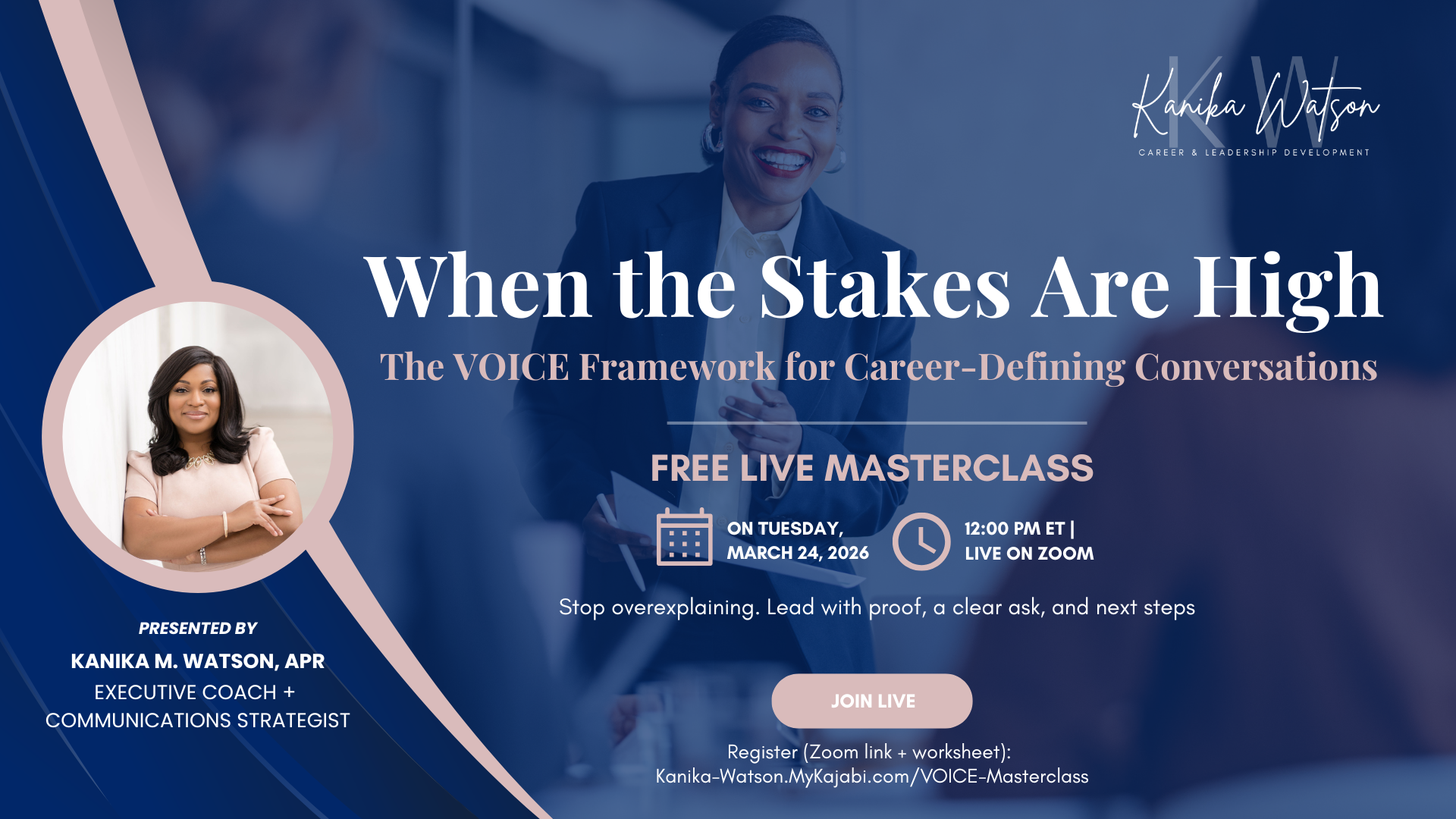
I’ll walk you through the structure I use to help professionals prepare for conversations with stronger positioning and a grounded ask.
If you need a clear way to pinpoint what has changed, organize your proof, and speak to what should happen next, I’d love to have you there.
Please feel free to register and share with others who may find it useful.